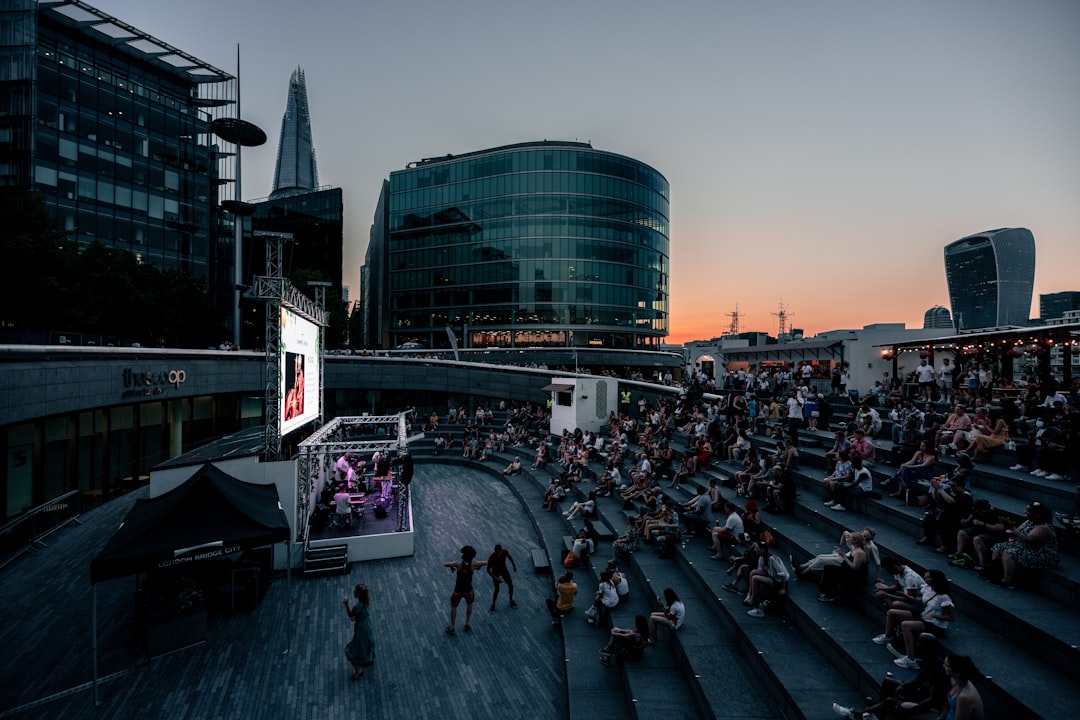
Outdoor theatre in London is at its most intense right now, and the final weeks of summer bring some of the most ambitious free performances the city produces each year.
Why late summer is the best time to watch outdoor theatre
Many visitors and residents plan their outdoor theatre visits for June or July. That is a reasonable choice. But the real concentration of free, large-scale outdoor performance lands in August and early September. Family and outdoor shows dominate this period, as it is the peak of the outdoor theatre season. Temperatures are still warm at dusk, the light fades at a useful hour for dramatic effect, and several major free festivals overlap. If you have not yet planned an evening outside, this guide covers 7 specific performances to consider before the season closes.
A practical note before you begin: some shows require free advance booking, and capacities fill quickly. Check each event’s official page before you travel.
360 by Mehdi Kerkouche, Woolwich (GDIF)
The Greenwich + Docklands International Festival opened on 21 August with 360, a new work from French choreographer Mehdi Kerkouche that turns General Gordon Square in Woolwich into a dance arena where propulsive movement, immersive set design, and electronic music combine. For a French writer working in London, this felt like a personal moment. Kerkouche is one of the most recognized names in contemporary French choreography, and seeing his work staged free in east London is the kind of opportunity that rarely repeats.

The square itself adds meaning. General Gordon Square sits in the heart of a neighborhood that has changed dramatically over the past decade. The contrast between the architecture and the performance creates an unexpected tension that makes the work more powerful.
Efectos Especiales by a company from Argentina (GDIF)
The obvious showstopper of the GDIF programme is Efectos Especiales from Argentina (29 and 30 August), which creates a stunning action movie, complete with weather and vehicles, and places the audience directly inside it. This is not a conventional theatre experience. The company uses the outdoor environment as a film set, and the audience becomes part of the scene. It is the kind of production that genuinely has no equivalent indoors.
The festival takes place over 3 weeks at the end of the summer, and the outdoor shows look particularly impressive as the sky darkens at night. Efectos Especiales is designed precisely for that darkness. Arrive early and choose a position that gives you space to move.

The Aunties: the house of masks, Woolwich (GDIF)
Oluwatosin Omotosho’s dance-theatre show The Aunties: The House of Masks performs at Beresford Square on 31 August, and it is a celebration of West African aunties. The work sits at the intersection of dance, theatre, and cultural memory. It is exactly the type of performance that outdoor settings make possible: rooted in community, designed for open space, and free to attend.
This is also one of the more intimate works in the GDIF programme. Beresford Square is a working market space, and that context gives the piece a grounded energy. This is not a production that could exist on a conventional stage.
Dancing City, Stratford (GDIF)
Dancing City takes place across Stratford on 5 September and is one of the established recurring elements of the GDIF programme. The format distributes performances across multiple locations in one neighborhood, so the audience moves between them. This is a format that works well in Stratford, where the public spaces around the Olympic Park and the high street create a sequence of distinct performance environments.
If you have not visited Stratford recently, this is also a good opportunity to see how the area has developed. The combination of architecture, open space, and live performance makes it a full afternoon or evening activity without any entry fee.




Shakespeare’s A midsummer night’s dream, Shakespeare’s Globe
The Globe’s summer season is led by a Midsummer Night’s Dream defined by a sunny attitude and large quantities of audience interaction, directed by Emily Lim, a specialist in large-scale community theatre. Standing tickets in the yard, known as groundling places, are available at a significantly lower price than seated tickets, and for some performances they represent one of the most affordable professional theatre experiences in London.
Shakespeare’s Globe replicates the original playing conditions that Shakespeare and his actors would have known, with a roof that leaves the audience exposed to the elements and space for up to 700 groundlings to stand in the yard. On a warm August evening, standing in the yard for this production is the closest London comes to theatre as a shared public event.
Expert perspective on free outdoor theatre
Free outdoor theatre is not a compromise version of culture. It is a distinct form with its own logic, its own relationship to place, and its own audience contract. When a company performs in a public square or a park, they cannot rely on the frame of a building to create attention. Every element of the production must work harder. The best outdoor theatre in London understands this. It uses scale, light, movement, and the specific character of each location as dramaturgical tools. Audiences who attend free outdoor events also bring a different energy than ticket-buying audiences in seated venues. That exchange between performers and a genuinely public crowd produces results that no indoor theatre can replicate. This is why cities that invest in free outdoor performance build cultural habits that last across generations.
Industry perspective, outdoor and public arts programming professionals, London

Shakespeare in the squares: Love’s Labour’s Lost across London neighborhoods
Shakespeare in the Squares ran its 10th edition with a troupe of actors performing in the city’s picturesque garden squares and parks. The 2026 production was Love’s Labour’s Lost, a comedy of flirtation and foolishness, with 1960s and 1970s rock and pop classics added to the programme. Among the participating locations were Crystal Palace Park, Montagu Square in Marylebone, Kensington Gardens Square, Cleveland Square in Paddington, Camden Square, and Fortune Green in West Hampstead.
If you missed the main run, check the Shakespeare in the Squares website for any additional or late-season dates. The format travels well, and the intimate scale of the garden squares means every performance feels personal rather than large-scale. It is also a good way to visit corners of London that even long-term residents often overlook.
Free outdoor theatre in London: why you should go this week
Free outdoor theatre in London is not a secondary option. It is where some of the most ambitious and original work happens each summer. The 7 performances in this guide represent a range of forms, scales, and neighborhoods, from a French choreographer filling Woolwich with electronic dance to Shakespeare performed between flower beds in Marylebone. Each experience is free or very low cost, and each one uses the outdoor setting as an essential part of the work.
Before the season closes, choose 1 or more of these performances and go. Outdoor theatre in London rewards the decision to simply show up.